
Many lifters overlook the significance of human performance metrics when it comes to enhancing their deadlifting technique. By focusing on these metrics, I believe you can significantly improve your lifting efficiency, track your progress, and reduce the risk of injury. Understanding aspects like force production, muscle activation, and movement patterns allows you to tailor your training program for optimal results. In this post, I will guide you through the key metrics you should consider and how they can transform your deadlifting approach for better gains and safety.
Key Takeaways:
- Understanding human performance metrics helps identify individual strengths and weaknesses, allowing for tailored training programs that enhance deadlifting technique and efficiency.
- Tracking metrics such as grip strength, speed of lift, and endurance can reveal patterns in performance, guiding adjustments in technique or training intensity for improved results.
- Using performance data to set realistic, measurable goals promotes motivation and accountability, ensuring consistent progress in deadlifting performance over time.
Unpacking Human Performance Metrics Specific to Deadlifting
Understanding the specific human performance metrics applicable to deadlifting allows you to tailor your training for optimal results. Elements such as strength, endurance, and technique work in harmony to improve your lifting capabilities. By diving deeper into these metrics, you can assess your progress, set achievable goals, and fine-tune your training sessions to enhance your overall performance.
Key Metrics to Monitor: Strength, Endurance, and Technique
Focusing on three important metrics—strength, endurance, and technique—is fundamental to becoming a proficient deadlifter. Strength reflects your ability to lift heavy loads, while endurance measures how long you can maintain that effort during rep ranges. Technique encompasses your lifting form and execution, which is vital for maximizing efficiency and preventing injuries.
The Role of Mobility and Flexibility in Performance
Mobility and flexibility play a pivotal role in your deadlifting success. They allow you to achieve optimal range of motion, thereby facilitating proper lifting mechanics. Tight muscles, particularly in the hips and hamstrings, can hinder your form and lead to compensatory movements that increase the risk of injury.
Incorporating mobility exercises and stretches specific to the hips, lower back, and legs can significantly enhance your deadlifting performance. For instance, a study found that individuals who routinely performed dynamic stretches before lifting increased their deadlift capacity by up to 10%. Improving flexibility not only contributes to safer lifting practices but also allows deeper lifting postures, enabling you to leverage more muscle fibers for maximal force production. Exploring techniques like yoga, foam rolling, or dynamic warm-ups before your sessions can set you on a path to achieving your deadlifting goals more effectively.
The Psychological Factors Influencing Deadlift Success
Understanding the psychological factors that play into deadlifting performance can significantly enhance your training approach. Confidence, for example, directly impacts your lifting capacity; a positive mindset can lead to improved strength output. Additionally, your emotional state can influence muscle activation and recovery. I’ve seen lifters struggle not due to physical limitations, but because of self-doubt and anxiety. The interplay between mental fortitude and physical performance can’t be overstated. Assume that you recognize these psychological elements to harness the full potential of your deadlift training.
Motivation and Goal Setting: Cultivating a Winning Mindset
Staying motivated is important for achieving peak deadlifting performance. I find that setting specific, measurable, achievable, relevant, and time-bound (SMART) goals keeps me focused and driven. Breaking down larger targets into smaller milestones makes progress tangible, increasing my determination. Celebrating small victories along the way fuels my enthusiasm and dedication. A thriving mindset reinforces my physical capabilities, solidifying the connection between motivational strategies and deadlifting success.
The Impact of Stress and Recovery on Performance
Stress management and adequate recovery play a critical role in optimizing your deadlift performance. High stress levels can lead to fatigue, hinder recovery, and decrease overall strength output, while proper recovery techniques maximize gains. The relationship between stress and recovery is nuanced. Chronic stress can elevate cortisol levels, which negatively impacts muscle repair and growth, ultimately undermining your deadlifting efforts. Conversely, integrating recovery methods, such as active rest, nutrition, and mental relaxation exercises, can enhance your body’s resilience to stress. I’ve noticed that my lifting sessions are far more effective when I prioritize quality sleep and actively manage stress through mindfulness or meditation. Assure that you consistently monitor both your stress levels and recovery strategies, as they profoundly affect your lifting potential.
Crafting Your Training Program with Performance Data
Utilizing performance metrics allows you to design a more personalized training program. By analyzing your individual data, I can pinpoint specific strengths and weaknesses that influence your deadlifting technique and output. Incorporating documented studies, such as those exemplified in Biomechanical and Neuromuscular Insights into Deadlift, becomes imperative for modifying your routine effectively, ensuring optimal progress while minimizing the risk of injury.
Tailoring Repetitions and Loads to Your Metrics
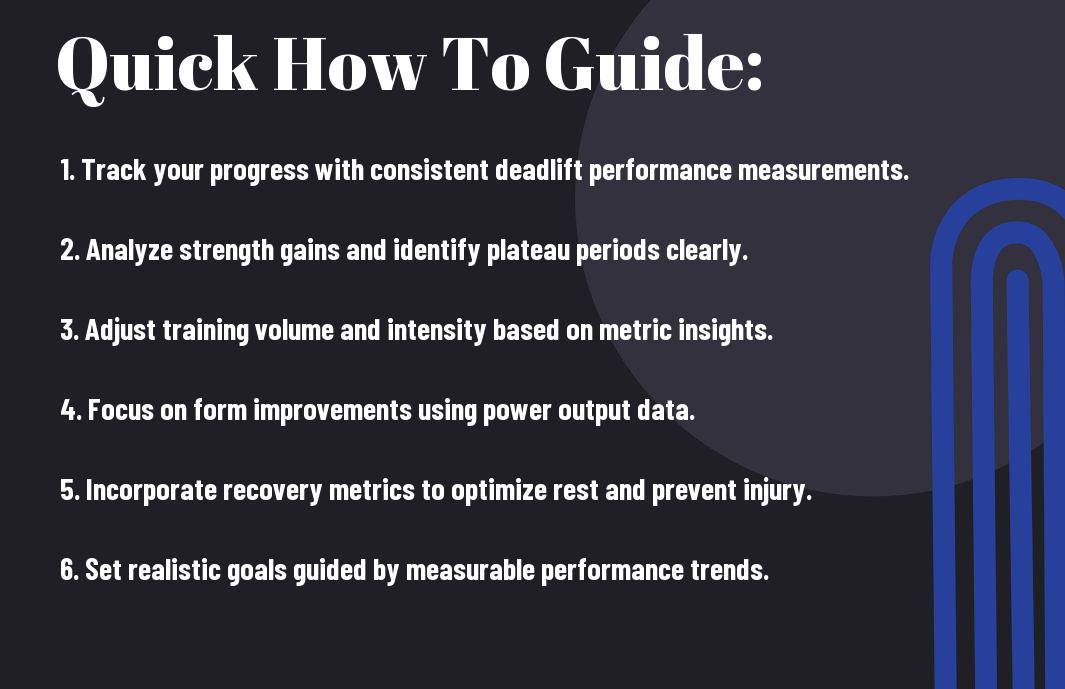
Data-driven insights help me select the appropriate number of repetitions and weights tailored to your physical capabilities. For instance, if your metrics reveal a higher neuromuscular readiness, I can implement heavier loads with fewer repetitions, stimulating maximum strength gains. Conversely, if endurance is shown to lag, I adjust the program to incorporate lighter weights with higher repetitions for better muscular stamina.
Incorporating Data-Driven Adjustments for Continuous Improvement
To guarantee that your training remains effective over time, I continuously analyze your performance data and make necessary adjustments. By tracking metrics such as bar speed, lift volume, and recovery time, I can adapt your program to match evolving needs. This ongoing analysis ensures optimal challenge levels while maximizing your results, fostering not just improvement but also a deeper understanding of your body’s responses to training stimuli.
Integrating these adjustments allows for agility in your training plan, ensuring you’re not stagnant or plateauing. For example, I might notice from your logging data that your recovery times have decreased significantly. This prompted an increase in intensity and volume, which might involve transitioning from a linear progression model to a more undulating periodization approach. This flexibility leads to continued progress—keeping you engaged, motivated, and moving towards your deadlifting goals.
Common Misconceptions Around Performance Metrics
Many lifters fall prey to the notion that tracking metrics like volume and frequency alone encapsulates the deadlift’s benefits. While they offer insights, reducing performance to just numbers overlooks broader physiological adaptations. For example, you can explore what makes the deadlift beneficial to you physiologically, revealing a richer understanding of how strength training influences muscle coordination and overall fitness.
Debunking Myths: Not All Metrics Are Created Equal
Different metrics serve different purposes, and making comparisons without context can mislead your training approach. For instance, one athlete’s deadlift may reflect their unique body mechanics and skill level, while another’s yields insights into their strength-endurance ratio. The numbers themselves hold less value than understanding what they signify within each individual’s training journey.
The Dangers of Overemphasizing Numbers without Context
Focusing solely on numbers can create a skewed perception of progress. While lifting 400 pounds may seem impressive, it doesn’t account for a lifter’s experience level, bodyweight, and overall technique. By neglecting factors like form, recovery, and training periodization, you risk injury or stagnation, leading to a disconnect between your data and actual performance improvements.
Without understanding the context behind each performance metric, you might misinterpret your progress or effectiveness in training. Suppose your deadlift numbers plateau; instead of panicking, consider exploring variations in rest periods, nutrition, or muscle recovery approaches. Evaluating metrics alongside qualitative feedback can reveal the subtleties that numbers alone may mask. This balanced view not only fosters growth but also sustains motivation, allowing you to appreciate the nuances of your development.
Leveraging Technology for Enhanced Insight
Technology has revolutionized how we analyze and enhance our deadlifting performance. Utilizing various tools, I can accurately capture my lifts, monitor physical metrics, and gain insights that sharpen my training strategies. From video analysis to wearable devices, these advancements provide a depth of understanding that traditional methods simply cannot offer. With real-time data at my fingertips, I can tweak my technique and ensure I’m continually progressing.
Tools and Apps for Tracking Deadlift Metrics
In my training, I rely on specific apps like MyFitnessPal for tracking nutrition and TrainHeroic for logging workouts. These tools allow me to record my deadlift performance metrics such as weight, sets, and reps, while advanced features let me examine my lifting form through video uploads. Wearable technology like smartwatches can also measure heart rate and caloric burn, providing comprehensive insights into my overall exertion levels.
Interpreting Data: Making Informed Decisions for Future Gains
After gathering data from my training sessions, the next step involves analyzing it to make informed decisions. My focus is on recognizing trends—such as how often I achieve personal records or when my lifts plateau. For instance, if my 1RM hasn’t increased over several weeks, I consider adjustments to my program or recovery strategies. This data-driven approach enables me to tweak my training effectively, ensuring I’m always moving toward my goals.
Diving deeper into interpreting data truly opens up avenues for significant improvement. For example, if I notice that my lifts start to regress after a particular volume microcycle, I can look back at my metrics to determine if fatigue from excessive lifting is the culprit. Analyzing the frequency of my deadlifting, combined with my recovery times, helps me to optimize my training schedule. Additionally, correlating my diet and sleep patterns with performance outcomes often reveals powerful insights, steering me toward adjustments that elevate my overall lifting prowess.
To wrap up
With these considerations, I find that understanding human performance metrics significantly enhances my approach to deadlifting. By focusing on metrics like strength-to-weight ratio, range of motion, and recovery times, you can tailor your training regimen for optimal results. This knowledge not only allows me to track progress more effectively but also helps in identifying areas for improvement. By applying this data-driven approach, you can ultimately achieve higher lifts while minimizing the risk of injury, thus becoming more efficient and effective in your deadlifting journey.