


Time plays a vital role in muscle hypertrophy, especially when it comes to compound lifts like squats and deadlifts. By adjusting the time under tension during your workouts, you can substantially enhance your muscle growth and strength gains. In this post, I will guide you through the concept of time under tension and how manipulating it effectively can lead to better results in your training. You’ll learn the techniques to implement this principle for optimal performance and muscle development.

Key Takeaways:
- Manipulating time under tension (TUT) impacts muscle hypertrophy by altering the duration during which muscles are under strain, promoting greater metabolic stress and muscle fiber recruitment.
- Incorporating varying tempos in compound lifts, such as slowing down eccentric phases, can enhance muscle growth by increasing the overall time the muscles spend being challenged.
- Effective use of TUT should be balanced with adequate loading and progression strategies to ensure continued gains and prevent adaptation or overtraining.
The Physiology of Time Under Tension
Focusing on the intricacies of Time Under Tension (TUT) reveals how it impacts muscle growth during compound lifts. By manipulating TUT during your workouts, you can optimize the stress placed on your muscles, leading to enhanced hypertrophy. Understanding the physiological responses to TUT helps in crafting targeted training programs that yield significant results.
Defining Time Under Tension (TUT)
TUT refers to the total time your muscles are under strain during an exercise. This metric not only impacts muscle hypertrophy but also influences the recruitment of muscle fibers and overall strength gains. Generally, a TUT of around 30-60 seconds per set is recommended to stimulate optimal muscle growth.
The Role of Muscle Fiber Recruitment and Activation
Effective muscle growth relies heavily on the recruitment and activation of muscle fibers. When performing compound lifts, I engage various muscle groups, but not all fibers are activated simultaneously. Longer TUT can enhance the ability to recruit fast-twitch muscle fibers, which are predominantly responsible for strength and power. Encountering resistance over extended periods demands greater fiber engagement, thereby triggering physiological adaptations that can lead to increased muscle size and strength.
One study showed that lifters who maintained a TUT of 40-60 seconds led to higher muscle recruitment compared to shorter TUTs. This is attributed to the energy demands and metabolic stress that longer sets induce, fostering muscle activation and growth. By focusing on the eccentric (lowering) and concentric (lifting) phases while prolonging TUT, I’m able to optimize my workouts and drive significant adaptations in my muscle structure and performance.
Compound Lifts: A Closer Look
Compound lifts are exercises that engage multiple muscle groups and joints simultaneously. Movements like squats, deadlifts, and bench presses not only build strength but also maximize efficiency in your workout by targeting larger muscle groups. Understanding the nuances of these lifts, particularly in relation to time under tension: How it actually affects muscle growth, helps in tailoring a more effective training regimen that aligns with your goals.
Key Benefits of Compound Lifts
One of the main advantages of compound lifts is their ability to stimulate greater overall muscle growth. Since these lifts recruit several muscle groups at once, they facilitate the release of hormones like testosterone and human growth hormone, important for muscle repair and growth. Moreover, because they mimic natural body movements, they also improve functional strength and enhance athletic performance.
How TUT Changes the Dynamics of Compound Movements
Implementing TUT in compound movements alters not just the intensity but also the effectiveness of your workouts. By manipulating how long a muscle is under tension during exercises, you create a challenging environment that demands more from your muscles, leading to hypertrophy and strength gains. For instance, extending the eccentric phase of a squat by lowering the weight more slowly amplifies muscle fiber engagement and increases metabolic stress.
Adjusting TUT during compound lifts means strategically varying your lifting tempo. For example, during a bench press, focusing on a slower descent effectively increases the time each muscle is actively engaged, which can intensify the workout’s overall effect. Studies suggest that this heightened focus on TUT can lead to 20% more muscle growth over time compared to traditional lifting speeds, underscoring the importance of how you manipulate tension in your training. You’ll find that not only do you become stronger, but your muscle definition may improve significantly as well, providing a visual advantage along with physical improvements.
The Science Behind Muscle Growth Triggered by TUT
When we talk about maximizing muscle growth, time under tension (TUT) emerges as a key player in the process. Research indicates that prolonging the duration your muscles are under strain during compound lifts fosters a more significant anabolic response. This occurs through a combination of factors, including increased metabolic stress and muscle fiber recruitment. By manipulating TUT, you stimulate various physiological pathways that ultimately contribute to hypertrophy, emphasizing not only the amount of weight lifted but also the way we perform our lifts.
Mechanotransduction: How Tension Turns into Growth
Mechanotransduction refers to the process by which cells sense and respond to mechanical load. When you perform compound lifts with a focus on TUT, your muscles experience heightened levels of tension, which triggers cellular signaling pathways. These pathways activate genes responsible for muscle growth, leading to the production of proteins that bolster muscle fibers. As you progress, this continuous cycle of tension and adaptation helps increase muscle size and strength.
The Influence of Different TUT Ratios on Hypertrophy
Experimenting with various TUT ratios can lead to different muscle growth outcomes. Research often points to a ratio of approximately 2:1:1 of eccentric to isometric to concentric phases as effective for hypertrophy. This means spending twice as much time in the eccentric phase compared to concentric. Adjusting these ratios can shift the balance of mechanical stress vs. metabolic stress experienced by the muscle, ultimately influencing the pathways that yield hypertrophic gains.
For instance, focusing on a 3-second eccentric phase, a 1-second isometric hold at the midpoint, and a 1-second concentric lift maximizes muscle tension while enfolding metabolic stress, driving up muscle protein synthesis. The specific ratios you employ will dictate whether you lean more towards strength or size gains. Thus, shifting your training emphasis across the spectrum of TUT can elicit diverse growth responses, tailoring your lifts to meet specific goals.

Practical Strategies for Implementing TUT in Workouts
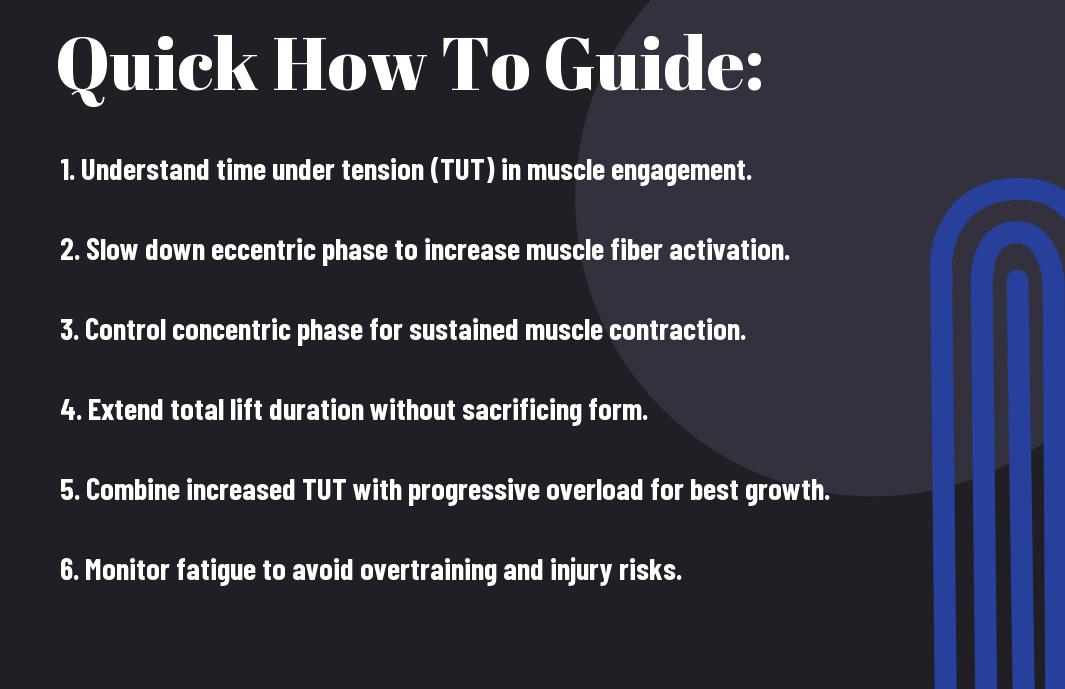
To maximize the benefits of time under tension (TUT) in your workouts, I recommend incorporating techniques such as slow eccentric phases and controlled concentric movements during your compound lifts. You can experiment with varying TUT by adjusting your tempo—try pausing for a count of three during the lowering phase or extending the explosive part of the lift to ensure your muscles remain engaged throughout the movement. This not only enhances the effectiveness of your workouts but also adds a fresh challenge to your routine.
Methods to Manipulate TUT in Compound Lifts
Manipulating TUT effectively can be achieved through several methods. For instance, employing a slower rep tempo of around 3-5 seconds during the eccentric phase and maintaining a controlled 1-2 seconds during the concentric phase can significantly increase the length of time your muscles are under tension. Additionally, incorporating pauses at various points in the lift, such as just above parallel in squats, can increase the overall time spent under load, further promoting muscle hypertrophy and strength adaptations.
Training Variables to Consider for Optimal Results
Adjusting training variables like intensity, volume, and rest periods is necessary for optimizing TUT effects. For example, I find that using approximately 60-75% of my one-rep max for compound lifts while maintaining a higher rep range (8-12 reps) allows me to maximize TUT without compromising form. Also, I pay attention to rest intervals, keeping them shorter (60-90 seconds) to encourage muscular fatigue and maintain elevated TUT across sets. This blend of intensity, volume, and timing helps create the ideal conditions for muscle growth.
Incorporating these training variables into your regimen creates a powerful synergy for maximizing TUT. When you set your intensity lower to allow for more prolonged tension, maintaining a higher rep scheme leads to increased metabolic stress on your muscles. Pair this with shorter rest periods to keep the muscular fatigue high, and you’ll find yourself pushing beyond previous limits. Tracking your progress and making adjustments based on how your body responds is vital for continued growth and adaptations. Each of these variables interacts with TUT, magnifying your efforts toward achieving significant muscle gains.
Potential Pitfalls: Common Misconceptions about TUT
Many individuals misinterpret time under tension (TUT) as a standalone magic bullet for muscle growth. They might believe that longer reps are the only way to stimulate hypertrophy, ignoring the value of intensity and rep range. This blind adherence to TUT principles can lead to imbalances in training and reduce overall effectiveness. For further insight, I recommend exploring how time under tension affects muscle growth compared to traditional methods.
Overemphasis on Slow Movements
While slow movements can be beneficial for maximizing TUT, focusing exclusively on them can compromise the effectiveness of compound lifts. This approach may lead to improper form and altered muscle engagement, ultimately stunting muscle growth. Striking the right balance between controlled and explosive movements can yield better overall results.
Balancing TUT with Overall Training Volume and Intensity
Optimizing muscle growth involves striking a balance between time under tension, training volume, and intensity. Simply increasing TUT without considering the overall structure of your training may lead to diminishing returns. For instance, if you focus solely on long, slow sets, you may inadvertently decrease your overall workload and intensity, hindering muscle adaptation. A well-rounded approach that incorporates varied TUT alongside sufficient weight and volume ensures that your muscles are continuously challenged and stimulated for growth.
Conclusion
Conclusively, manipulating time under tension plays a significant role in muscle growth during compound lifts. By adjusting the tempo of your lifts, I can increase the time my muscles are under tension, thus promoting hypertrophy and strength gains. This technique not only helps in maximizing your workouts but also builds better muscle endurance. If you’re interested in exploring this concept further, I encourage you to check out The Impact of Tempo and Time Under Tension on Strength for more insights.